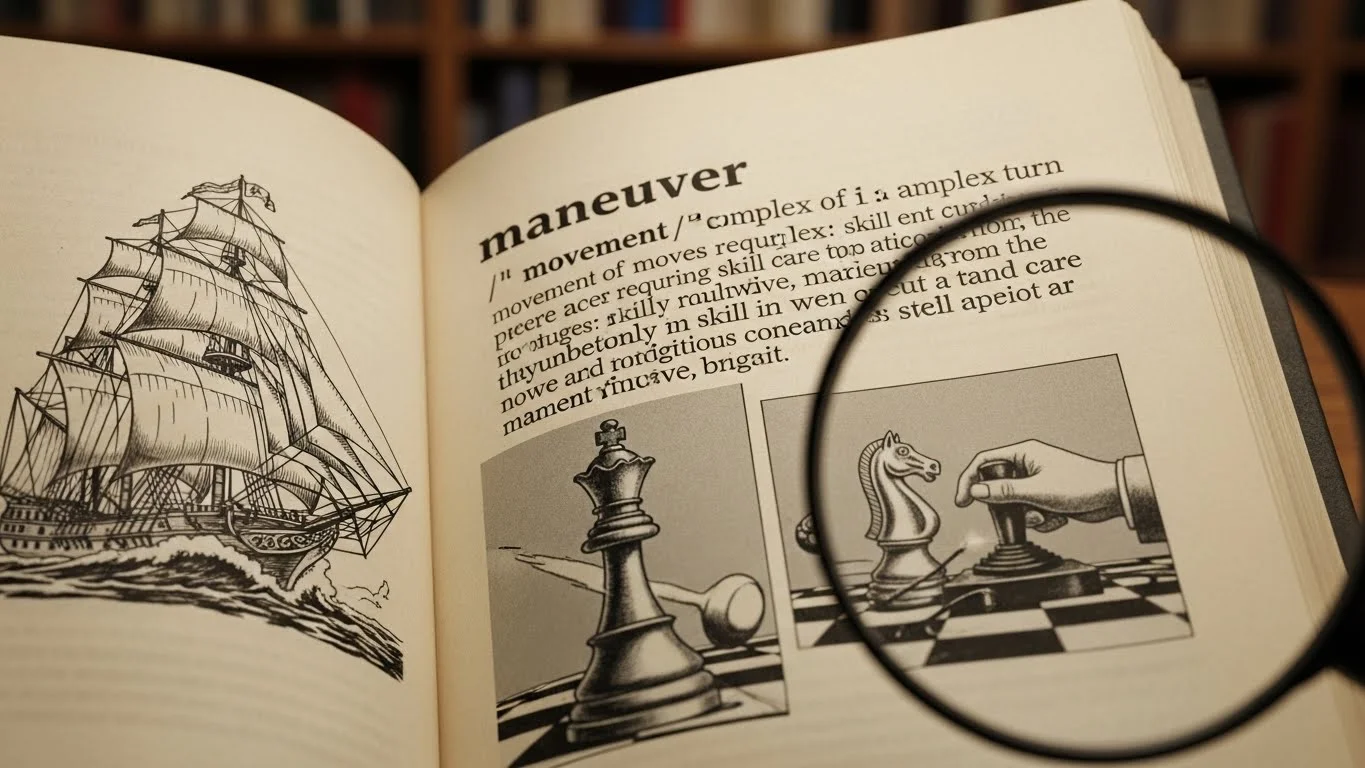

Maneuver Meaning in English
As a noun and a verb, maneuver generally refers to:
Noun: A planned or skillful movement or action
Verb: To move or handle something skillfully, often with strategy
Examples:
Noun: “The driver executed a perfect maneuver to avoid the obstacle.”
Verb: “She maneuvered the car into the tight parking spot.”
Key idea: Maneuver = controlled, skillful, or strategic movement.
Maneuver in Military Context
Historically, maneuver is heavily associated with the military:
Refers to strategic troop movements or operations
Involves planning, skill, and coordination to gain advantage
Common in historical and modern military training
Example:
“The army carried out a flanking maneuver to surprise the enemy.”
In military contexts, it emphasizes strategy and precision.
Maneuver in Driving and Sports
In everyday life, maneuver is used for skillful handling of vehicles or physical actions:
Driving: Turning, parking, or avoiding obstacles
Sports: Quick, calculated movements to gain an advantage
Examples:
“He skillfully maneuvered through traffic.”
“The gymnast performed a complicated maneuver on the balance beam.”
Maneuvering implies dexterity, control, and timing.
Maneuver in Figurative Language
Maneuver is also used metaphorically to describe strategic actions in non-physical contexts:
Politics: “The senator’s speech was a clever maneuver to gain support.”
Business: “The company maneuvered to dominate the market.”
Personal life: “She maneuvered through the conversation to avoid conflict.”
Here, maneuver refers to tactics, planning, or clever handling of situations.

Maneuver Synonyms
Words similar to maneuver include:
Move
Tactic
Strategy
Operation
Action
Feint
These can be used depending on whether the context is literal or figurative.
Maneuver Antonyms
Opposites of maneuver might include:
Blunder
Mistake
Misstep
Fumble
These highlight lack of control, planning, or skill.
Common Misunderstandings
Maneuver ≠ random movement: It always implies skill, control, or strategy
Not always physical: Can describe mental, strategic, or social actions
Spelling note: In American English, it’s “maneuver”; in British English, both “manoeuvre” and “maneuver” are correct

Real-Life Examples of Maneuver
“The driver maneuvered around the parked cars.”
“She used a clever maneuver to win the debate.”
“The military exercise involved multiple complex maneuvers.”
“He maneuvered through the crowd without bumping anyone.”
These examples cover physical, figurative, and professional uses.