

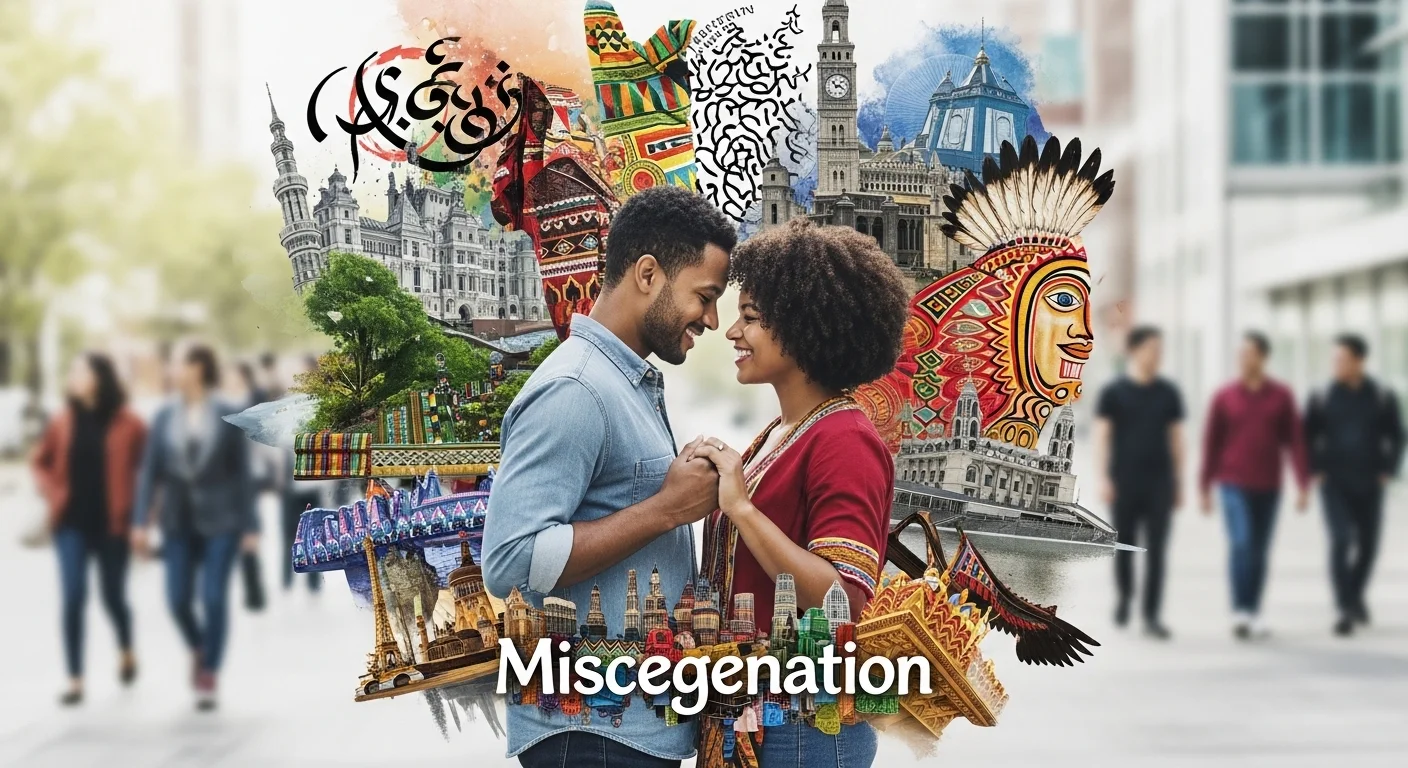
What Does “Miscegenation” Mean?
Miscegenation refers to the mixing of races through marriage, sexual relations, or reproduction.
Literal meaning: Interracial relationships or unions that result in children of mixed racial backgrounds.
Historical meaning: The term was historically used in laws and social contexts to discourage or prohibit interracial marriage, particularly in the 18th to 20th centuries.
Modern perspective: Today, it’s often discussed in academic, historical, or social studies contexts rather than everyday conversation.
Key point: While the term itself is neutral, historically it carried stigmatized and discriminatory connotations.
Historical Context of Miscegenation
Origin of the word: First appeared in 1863 in the United States, originally in political propaganda surrounding race and marriage debates.
Anti-miscegenation laws: Many U.S. states had laws prohibiting interracial marriage until the 1967 Supreme Court case Loving v. Virginia, which struck down these laws.
Global context: Laws and social taboos against intermarriage existed in Europe, Asia, Africa, and the Americas at different times.
Cultural significance: Studying miscegenation helps understand historical racism, colonialism, and social hierarchies.
How Miscegenation is Used Today
Academic discussions: In history, sociology, and anthropology classes.
Historical texts: Describing laws or societal attitudes regarding interracial relationships.
Social commentary: Used to discuss race, diversity, and acceptance.
Genealogy & genetics: Talking about mixed ancestry and family lineage.
Appropriate use:
Educational or scholarly contexts.
Social or historical discussions about race and diversity.
Awkward or inappropriate use:
Casual insults or derogatory remarks.
Ignoring the historical weight and sensitivity of the term.
Real-Life Examples of Miscegenation
Historical example: “Miscegenation laws in the U.S. prohibited marriage between Black and White individuals until 1967.”
Modern example: “Today, miscegenation reflects the growing diversity of families worldwide.”
Academic discussion: “The study analyzed patterns of miscegenation in colonial societies.”
Common Mistakes & Misunderstandings
Thinking it’s only a modern term: It has been used historically, often negatively.
Assuming it’s slang: Miscegenation is a formal, academic word, not casual slang.
Ignoring sensitivity: The term carries a history of discrimination and should be used respectfully.

Related Terms & Concepts
Interracial marriage: Modern, neutral term for marriage between people of different races.
Mixed-race: Describing a person with parents from different racial backgrounds.
Exogamy: Anthropological term for marrying outside one’s social or ethnic group.
Loving v. Virginia: Landmark U.S. Supreme Court case legalizing interracial marriage.
Racial integration: Broader social process that includes intermarriage and mixing.
Platforms Where Miscegenation is Discussed
Educational websites & history blogs: Explaining laws and historical context.
Social media discussions: Debates about race, diversity, and history.
Academic forums & journals: Sociological and anthropological studies.
Genealogy and ancestry sites: Understanding family lineage and mixed heritage.
How to Describe Miscegenation to Others
Explain it as interracial marriage or reproduction.
Mention historical context: “Historically, miscegenation was heavily regulated in many societies.”
Highlight modern usage: “Today, it reflects diversity and mixed-race families.”
How to Respond if Someone Mentions Miscegenation
Acknowledge the historical context: “Yes, miscegenation laws were part of systemic racism.”
Modern perspective: “Now it reflects more diverse and inclusive families.”
Academic discussion: “It’s an important topic in sociology and history.”
When Not to Use Miscegenation
Casual joking or memes about race—it can be offensive.
Insults or derogatory remarks.
Without understanding the historical or cultural significance.

Why Knowing Miscegenation Matters in 2026
Helps understand historical and social perspectives on race.
Improves communication in academic, social, or cultural discussions.
Encourages respectful dialogue about diversity and inclusion.