
Parallelogram Meaning in Simple English
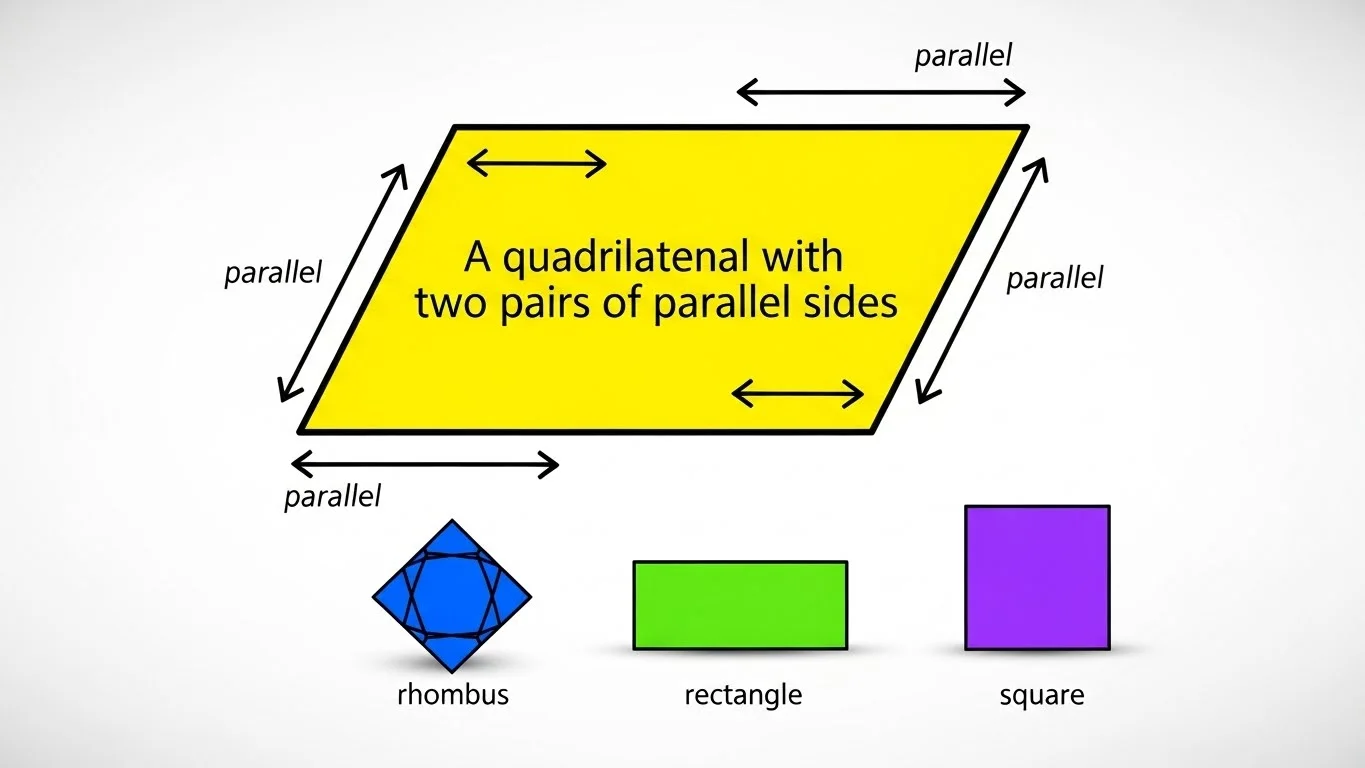
A parallelogram is a four-sided shape (quadrilateral) where:
-
both pairs of opposite sides are parallel
-
opposite sides are equal
-
opposite angles are equal
It looks like a slanted rectangle, but it does not stand straight up.
Shape and Basic Idea of a Parallelogram
Imagine a rectangle pushed sideways so it leans. It still has:
-
four sides
-
two sets of opposite parallel sides
That leaning shape is called a parallelogram.
It is a member of the family called quadrilaterals.
Properties of a Parallelogram
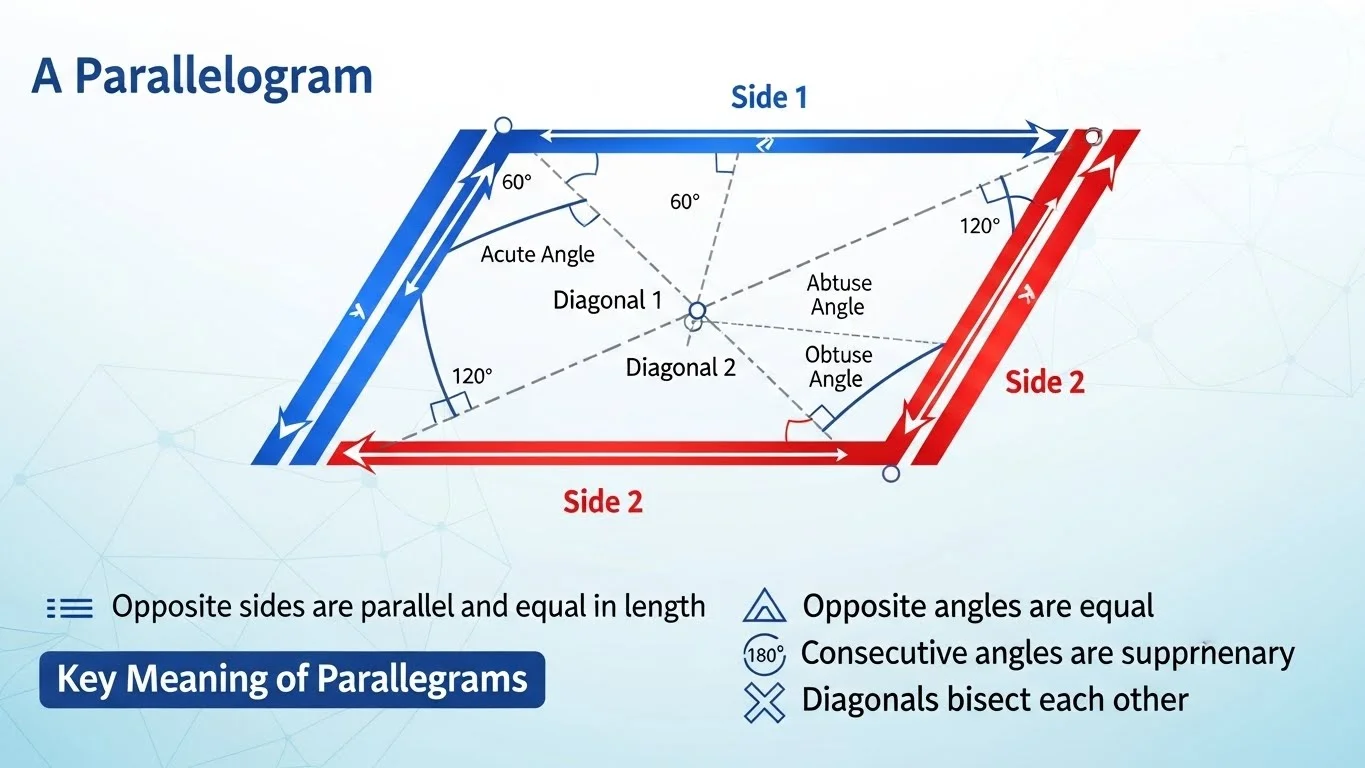
A parallelogram has some key properties:
-
opposite sides are equal in length
-
opposite sides are parallel
-
opposite angles are equal
-
adjacent angles add up to 180 degrees
-
diagonals bisect each other
These properties are why parallelograms are important in geometry.
Types of Parallelograms
A parallelogram has different special forms:
-
rectangle – all angles are 90 degrees
-
rhombus – all sides are equal
-
square – all sides equal and all angles 90 degrees
So, rectangle, square, and rhombus are actually special parallelograms.
Parallelogram vs Rectangle
A rectangle has:
-
all right angles
-
opposite sides equal and parallel
A general parallelogram:
-
may not have right angles
-
only guarantees opposite sides are parallel
A rectangle is a neat, straight parallelogram.
Parallelogram vs Rhombus
A rhombus:
-
has all four sides equal
A general parallelogram:
-
only has opposite sides equal
So every rhombus is a parallelogram, but not every parallelogram is a rhombus.
Parallelogram in Real Life
You can see parallelogram shapes in:
-
tiles
-
slanted windows
-
diamond-shaped road signs
-
graphic design patterns
-
kite shapes
-
architecture
-
folded book covers
They are also used in engineering linkages and machines.
Area of a Parallelogram (Explained Simply)
The area of a parallelogram is:
base × height
The “height” is the straight distance from the base to the opposite side, not the slanted side.
Diagonals of a Parallelogram
A parallelogram has two diagonals that:
-
cross each other
-
cut each other into equal halves
They may not be equal in length, but they always bisect each other.
How to Recognize a Parallelogram Quickly
A shape is usually a parallelogram if:
-
opposite sides are parallel
-
it looks like a slanted rectangle
-
it has equal opposite angles
Checking parallel sides is the easiest test.
Example Sentences Using “Parallelogram”
The teacher asked us to draw a parallelogram in geometry class.
A square is actually a type of parallelogram.
That window looks like a parallelogram because its sides are slanted.